You found the messages, Or the receipt, or the second phone, or the story that just didn't add up. And now, somehow, you're the one being yelled at. It doesn't make sense — they did this, so why are they the one who's furious?
If you're sitting with that exact confusion right now, you're not losing your mind. This reaction is more common than you'd think, and it actually follows a pretty predictable pattern once you understand what's driving it. Let's break down why it happens and what you can do about it, here's a quick answer.
Quick Answer
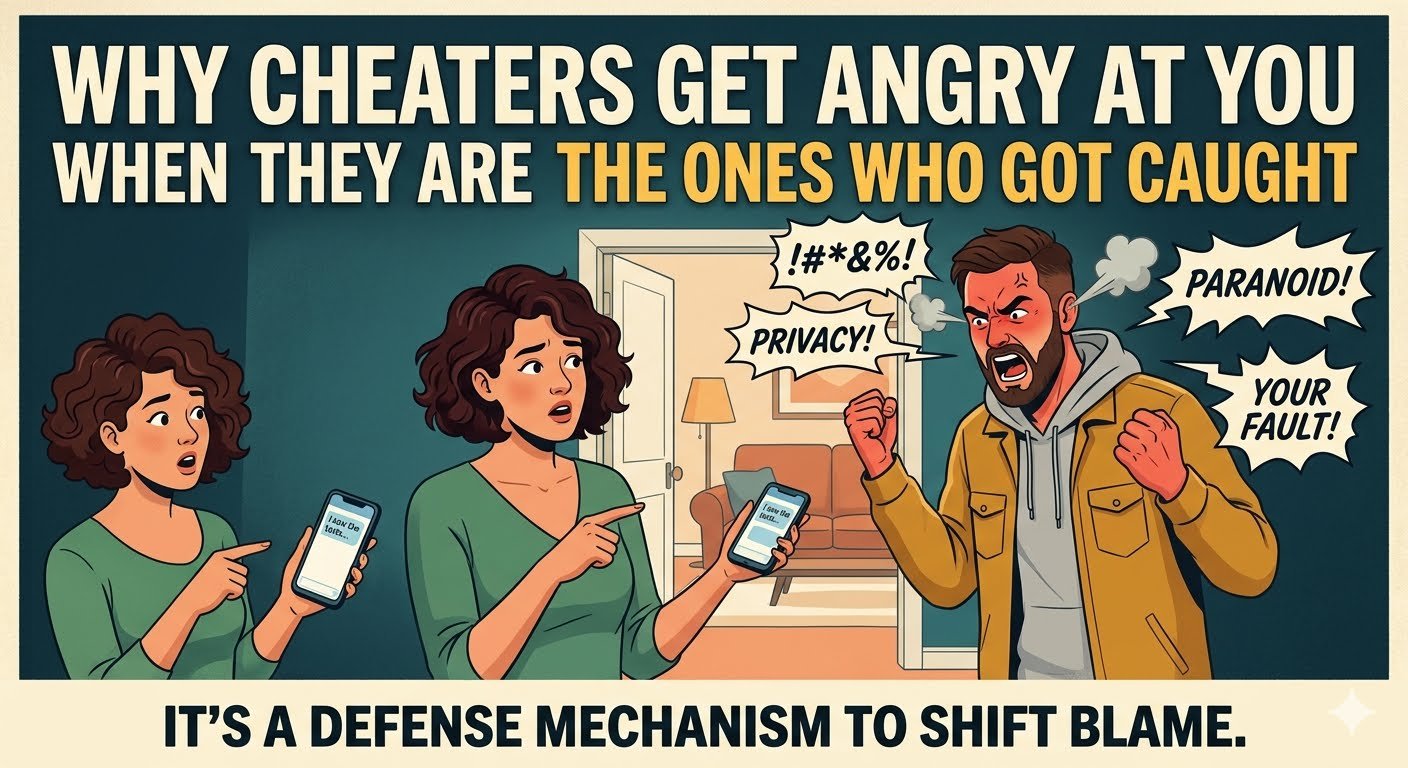
Cheaters get angry when caught mainly because anger is easier to sit with than guilt or shame. Getting caught threatens their self-image, so many people flip into defense mode — denying, deflecting, or attacking — instead of taking responsibility. This pattern even has a name in psychology: DARVO.
Why Do Cheaters Get Angry When Caught?
Here's the part that trips people up: anger rarely shows up first because someone's proud of what they did. It shows up because they got caught before they were ready to face it. In their head, they still had time — time to end it quietly, time to figure out what to say, time to avoid this exact conversation. You just took all of that away in one moment.
That loss of control is jarring. And for a lot of people, anger is simply a faster, more familiar reaction than sitting still with guilt.
The Real Reason: Guilt and Shame Don't Always Feel Like Guilt and Shame
Anger Is Usually a Secondary Emotion
Psychologists often describe anger as a "secondary" emotion — it shows up to cover something more uncomfortable underneath, like fear, embarrassment, or shame. When someone gets caught cheating, the first internal hit is usually shame: I did something I can't undo, and now someone I care about knows it. That's a hard feeling to sit in. Anger, on the other hand, feels active. It gives them somewhere to put the discomfort instead of absorbing it.
Why Deflecting Feels Safer Than Facing It
Owning up to cheating means admitting real things: that they lied, planned around it, and hurt someone on purpose or through carelessness. That's a lot to hold at once. Getting angry lets a person skip that step. Instead of asking "what did I do," their brain jumps straight to "how do I make this stop feeling so bad" — and blaming you is often the fastest exit.
Meet DARVO — The Pattern Behind the Anger
There's actually a name for this exact behavior. It's called DARVO, a term coined by psychologist Dr. Jennifer Freyd, who has spent decades researching betrayal and how people respond when confronted about wrongdoing. DARVO stands for Deny, Attack, and Reverse Victim and Offender, and it shows up constantly in infidelity situations.
Deny
This is the first move — flat denial, even in the face of clear evidence. "Nothing happened." "You're imagining things." It's meant to buy time and make you doubt what you already know.
Attack
When denial doesn't work, the focus shifts to you. Suddenly you're too controlling, too paranoid, too insecure, or "always looking for problems." The goal isn't logic — it's putting you on the defensive so you stop pressing.
Reverse Victim and Offender
This is the part that feels the most disorienting. The person who did the cheating starts acting hurt, wronged, or exhausted by your reaction, as if you're the one causing damage by simply asking questions. It flips the entire situation upside down, and it's often the moment people start second-guessing their own memory of events.
Why Do Men Get Mad When They Get Caught Cheating?
This pattern isn't limited to one gender, but it does show up often in conversations about men specifically. A lot of it traces back to ego. Being caught can feel like a direct hit to how someone sees themselves — smart, in control, someone who "wouldn't get sloppy." When that image cracks, some men respond with anger instead of vulnerability, because anger feels more powerful than admitting they got it wrong.
If You Accuse Someone of Cheating and They Get Mad
This is where things get tricky, because anger alone isn't proof of guilt. Getting accused of something you didn't do is genuinely upsetting, and a hurt, confused reaction is completely normal.
How Does an Innocent Person React When Accused of Cheating?
An innocent reaction tends to look different from a guilty one, even though both can involve frustration. Someone who's innocent usually:
● Asks why you think that, and actually listens to the answer
● Stays consistent with their story over time, even under pressure
● Gets hurt, but doesn't try to make you feel crazy for asking
● Is willing to talk it through more than once without shutting down
Someone using DARVO, by contrast, tends to escalate fast, avoid specifics, and pivot the conversation onto your behavior instead of the actual question.
Not All Cheater Anger Looks the Same
Type of Anger | What It Looks Like | What's Really Going On |
Guilt-driven anger | Defensive, snapping at small things, avoiding eye contact | Overwhelmed by shame, using anger to avoid sitting with it |
Ego or entitlement-driven anger | Dismissive, acts like you're overreacting | Self-image threatened; doesn't believe they should be questioned |
Shock or panic anger | Sudden, loud, chaotic reaction | Caught off guard before they had a "plan" for this conversation |
Why Do Cheaters Get Mad When You Move On?
It seems backwards, but it happens constantly. Someone who cheated and showed little remorse at the time can suddenly get upset watching you rebuild your life without them. Often it's less about missing you and more about losing the power they had in the situation. As long as you're upset, they still matter. Once you move on, that leverage disappears — and for some people, that stings more than the breakup itself.
Why Does My Husband Get Mad When I Ask Him If He's Cheating?
If this question alone triggers a big reaction — sighing, snapping, "why don't you trust me" — pay attention to the pattern, not just the moment. A one-time defensive reaction can just mean he feels hurt by the question. But if it happens every time, with no room for an actual conversation, that's closer to the DARVO pattern than simple annoyance.
He Got Caught Cheating and Now He Ignores Me
Silence after getting caught is its own kind of avoidance. Some people go quiet instead of angry because they don't have a script for what comes next, or because they're hoping the whole thing blows over if they just wait it out. It's not necessarily less manipulative than anger — it's just a different way of avoiding accountability.
When Do Cheaters Realize They Made a Mistake?
There's no fixed timeline here, and it's not guaranteed to happen at all. Some people recognize what they lost almost immediately, once the anger fades and reality sets in. Others take months, especially if the relationship truly ends and the consequences finally feel real instead of hypothetical. And some never fully get there, especially if they never had to face genuine consequences in the first place.
How to Respond When They Turn It Around on You
You don't need to win the argument in the moment. You need to stay steady.
● Name the pattern out loud if you recognize it: "I notice you're focused on me instead of what happened."
● Don't argue with the deflection. Bring the conversation back to the original issue, calmly and repeatedly if needed.
● Trust what you actually saw or found. Their reaction doesn't erase evidence.
● Give yourself permission to step away from the conversation if it turns into yelling. You can revisit it later, on your terms.
● Talk to someone outside the situation — a friend, therapist, or support group — so you're not processing this in isolation.
When the Anger Becomes a Pattern Worth Worrying About
Occasional defensiveness after a hard confrontation is human. But if anger becomes the go-to response every time you bring up something real, or if it starts to feel intimidating rather than just uncomfortable, that's worth taking seriously. Ongoing DARVO behavior can shade into emotional manipulation or abuse, and that's a different conversation than simply processing an affair.
Frequently Asked Questions
Why do people get mad when they get caught cheating?
Because anger is often easier to feel than guilt or shame. It gives them something active to do instead of sitting with the discomfort of what they've done.
How do cheaters react when they get caught?
Reactions vary, but common patterns include denial, deflection, anger, guilt-driven defensiveness, or sudden silence and avoidance.
Do cheaters get mad when accused?
Many do, especially if the accusation is accurate. The anger is typically a defense mechanism rather than proof of innocence or guilt on its own.
How do cheaters feel after being caught?
It's usually a mix — shame, fear of consequences, and sometimes relief that the secret is finally out, even if their outward reaction looks angry or defensive.
What is DARVO in a relationship?
DARVO stands for Deny, Attack, and Reverse Victim and Offender. It's a pattern where someone confronted about wrongdoing denies it, attacks the accuser, and then positions themselves as the real victim.
Conclusion
Their anger isn't a reflection of what you did wrong — it's a reflection of how uncomfortable they are with what they did. Once you can name the pattern, whether it's DARVO, ego, or plain panic, it loses a lot of its power to make you doubt yourself.
You're allowed to trust what you saw, ask the questions you need to ask, and expect a real answer instead of a reaction designed to shut you down.
.jpeg)
.jpeg)
.jpeg)
0 Comments